
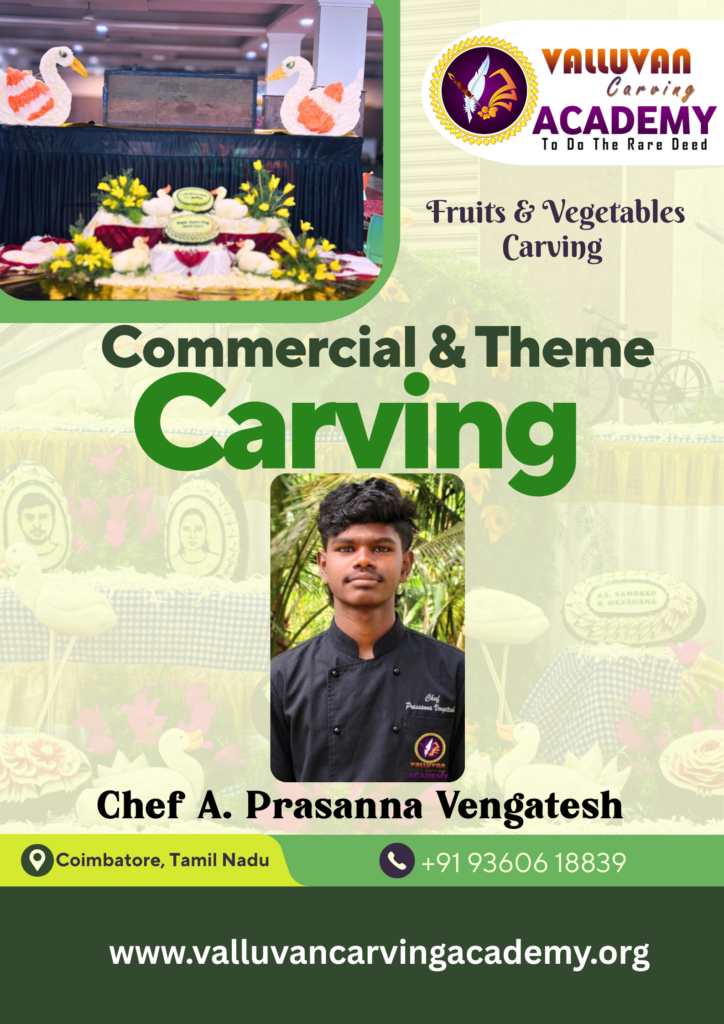

Introduction to Fruit and Vegetable Carving
Fruit and vegetable carving is the art of cutting and shaping fruits and vegetables into decorative designs, patterns, and sculptures. It is commonly used to enhance the presentation of food at banquets, hotels, restaurants, weddings, and special events.
This art originated in Thailand many centuries ago and has since become popular worldwide. Common fruits and vegetables used for carving include watermelon, pumpkin, carrot, cucumber, radish, papaya, and melon because of their colour, texture, and firmness.
Fruit and vegetable carving requires creativity, patience, and skill with carving tools. The main purpose is to make food visually attractive, improve table presentation, and create artistic displays for various occasions.
Objectives of Fruit and Vegetable Carving:
- Enhance food presentation.
- Develop artistic and creative skills.
- Create attractive centerpieces and garnishes.
- Increase the visual appeal of dishes.
- Add value to catering and hospitality services.
Types of Fruit and Vegetable Carving
Basic decorative cuts made from fruits and vegetables.
Examples: tomato roses, cucumber flowers, carrot curls.
- Floral Carving
- Fruits and vegetables are carved into flower shapes.
- Examples: lotus, rose, chrysanthemum, lily designs.
- Relief Carving
- Patterns and designs are carved on the surface without removing the entire shape.
- Commonly done on watermelon, pumpkin, and papaya.
- Three-Dimensional (3D) Carving
- Creates complete sculptures with depth and shape.
- Examples: birds, animals, fish, and decorative figures.
- Traditional Thai Carving
- Intricate floral and geometric patterns originating from Thailand.
- Requires advanced carving skills
- Functional Carving
- Fruits or vegetables are carved into useful items.
- Examples: fruit baskets, serving bowls, and decorative containers.
- Face and Figure Carving
- Human faces, cartoon characters, or statues carved from fruits and vegetables.
- Commonly done on pumpkins and watermelons.
- Landscape and Theme Carving
Designs based on nature, festivals, cultural themes, or special occasions.
Common Fruits Used for Carving
- Watermelon
- Melon
- Papaya
- Pineapple
- Apple
- Mango
- Orange
Common Vegetables Used for Carving
- Carrot
- Cucumber
- Radish
- Pumpkin
- Beetroot
- Turnip
- Tomato
These carving styles are widely used in hotels, catering services, food exhibitions, and special events to create attractive food displays.
Commercial Carving & Theme Carving
Commercial Carving :
Commercial carving refers to the professional art of carving fruits and vegetables for use in hotels, restaurants, catering services, food exhibitions, and special events. The primary purpose of commercial carving is to enhance the visual appeal of food displays and create attractive centerpieces that impress customers and guests. Commercial carving requires creativity, precision, and technical skill to transform ordinary fruits and vegetables into decorative designs, floral patterns, and artistic sculptures. It plays an important role in the hospitality and food service industry by improving presentation and adding value to culinary experiences.
Commercial Carving
Carving Details
1. Main Structure
- Bird Type: Swan
- Base used: thermocol
- Vegetable: White radish/daikon
- Body Shape: Oval and rounded, carved from a large radish block.
- Neck: Long curved “S” shape, giving the swan an elegant appearance.
- Tail: Raised and pointed upward to create a graceful finish.
2. Feather Work
- Thin oval slices of radish are layered one over another.
- The overlapping arrangement creates a realistic feather texture.
- Feathers are carved separately and attached carefully to the body and neck.
3. Beak
- Made from a yellow-coloured vegetable or fruit piece.
- Triangular shape with a slight opening to resemble a swan’s beak.
4. Eye
- Created using a small cucumber slice.
- Dark centre gives a natural eye effect.
- Positioned neatly to enhance the bird’s expression.
5. Decorative Flowers
- Orange carrot slices are carved into rose-like flowers.
- Placed on the swan’s body as decorative accents.
- Adds contrast and visual appeal.
Skills Used
- Basic vegetable carving
- Layered feather carving
- Flower carving (carrot roses)
- Assembly and presentation techniques
Suitable For
- Hotel buffet displays
- Wedding decorations
- Fruit and vegetable carving competitions
- Catering and banquet presentations
The carving demonstrates precision cutting, symmetry, layering, and artistic presentation, making it an excellent example of commercial vegetable carving.
Theme Carving :
Theme carving is a specialized form of fruit and vegetable carving in which designs are created based on a particular concept, occasion, culture, festival, or event. Carvers use fruits and vegetables to produce artistic displays that convey a specific message or theme, such as weddings, birthdays, religious celebrations, seasonal festivals, or environmental awareness. Theme carving combines creativity, imagination, and technical carving skills to create visually appealing exhibits that attract attention and enhance the atmosphere of an event. It is widely used in exhibitions, competitions, hotels, and special celebrations.
Carving details
Main Swan Carvings
- Two large swans are positioned symmetrically on the stage.
- The swans appear to be carved primarily from white radish, pumpkin, or similar white vegetables/fruits.
- Carrot is used as decorative feathers are carved and arranged to create a realistic wing pattern.
- The beaks are carved in yellow-orange colour, carrots and pumpkin giving a natural swan appearance.
- Each feather is individually shaped and layered, demonstrating advanced carving skills.
Decorative Base Arrangement
- Several smaller swan carvings are placed around the lower display.
- Yellow flowers and green foliage create a garden-like setting.
- White carved petals are spread across the base to resemble water or flower petals.
Watermelon Name Carving
- The centre features carved watermelons displaying:
- “Catering Name”
- Contact information
- Event dedication text
- The watermelon skin is intricately carved to create decorative borders and lettering.
Carving Techniques Used
- Relief Carving – feathers and floral patterns.
- 3D Carving – large swan sculptures.
- Watermelon Engraving – decorative text and borders.
- Layer Carving – overlapping feather effect.
- Decorative Arrangement – combining carved items with flowers and fabric.
Estimated Skill Level
- Advanced / Professional Commercial Carving
- Suitable for:
- Weddings
- Receptions
- Hotel buffet displays
- Catering exhibitions
- Special events
Short Description about the display
“The display showcases professional fruit and vegetable carving artistry featuring a pair of elegant swans, intricately crafted feathers, engraved watermelon decorations, and floral arrangements. The symmetrical design highlights creativity, precision, and craftsmanship, making it an attractive centrepiece for weddings, receptions, and catering events.”
Cost control :
| S.No | Items | Quantity | Amount per (kg) | Rate |
| 1. | Watermelon | 2 nos (6kg) | ₹20 | ₹120 |
| 2. | Radish | 5kg | ₹40 | ₹200 |
| 3. | Yellow cucumber | 5 nos (5kg) | ₹50 | ₹250 |
| 4. | Carrot | 2.5 kg | ₹70 | ₹175 |
| 5. | Thermocol | 2 nos | ₹80 | ₹160 |
| 6. | Satay stick | 1 pkt | ₹35 | ₹35 |
| 7. | Ball pin | 1 box | ₹40 | ₹40 |
| 8. | Asparagus leaf | 2 bundle | ₹50 | ₹100 |
| 9. | Oasis sponge | 2 pic | ₹50 | ₹100 |
| 10. | Yellow Pumpkin | 1 kg | ₹20 | ₹20 |
| 11. | Green Leafy Vegetables | 1 bundle | ₹20 | ₹20 |
| 12. | Cabbage | 1 nos (1kg) | ₹40 | ₹40 |
| 13. | Transportation Charge | ₹300 | ||
| 14. | Labour Charge | ₹1000 | ||
| Total Expenses | ₹2560 | |||
Budget of Commercial Carving:
A commercial fruit and vegetable carving display was prepared with a total project value of ₹4,000. The expenses incurred for purchasing fruits, vegetables, carving tools, decorative materials, transportation, and labour charges amounted to ₹2,560.
Budget Details
| Particulars | Amount (₹) |
|---|---|
| Total Cost of Carving Display (Revenue) | 4,000 |
| Total Expenses | 2,560 |
| Profit | 1,440 |
Calculation of Profit
Profit = Total Revenue − Total Expenses
Profit = ₹4,000 − ₹2,560 = ₹1,440
Explanation
The commercial carving display generated a total income of ₹4,000. After deducting all expenses of ₹2,560, a net profit of ₹1,440 was earned. This indicates that the carving project was financially successful, as the income exceeded the expenses.
Conclusion:
Commercial food carving represents a sophisticated intersection of culinary arts, aesthetic theory, and professional craftsmanship. Rooted in centuries-old traditions, this discipline has undergone significant evolution, transitioning from ceremonial palace kitchens to contemporary event management and hospitality industries.
From an academic standpoint, commercial carving can be understood as a form of applied visual art, wherein perishable organic materials — fruits, vegetables, and ice — serve as the medium for structured artistic expression. The technical competencies required, including spatial reasoning, fine motor precision, and compositional balance, are comparable to those demanded in conventional sculptural practices.
Furthermore, the commercialization of this craft reflects broader socio-cultural shifts in event aesthetics and consumer expectations. As experiential value becomes increasingly central to modern celebrations, food carving functions not merely as decoration but as a symbolic marker of prestige, cultural identity, and professional excellence.